Surprising fact: in side-by-side tests I ran over several days, WD-40 resisted ghosting better than Teflon and untreated controls, even though it left a strong scent that needed ventilation.
I wrote this guide because I wanted a fast, repeatable way to get my whiteboard usable again. I tested simple products I keep on hand and a few pro tricks. Microfiber towels removed ink far better than felt erasers in my trials.
For light maintenance I used a refillable spray with isopropyl alcohol and a soft cloth. For stubborn stains I moved up a cycle: toothpaste scrub, alcohol wipe, then WD-40 for resurfacing. The permanent marker trick also saved me time: trace, let dry, then wipe.
My goal was practical results you can trust. I’ll point out when a quick wipe is enough and when a full restoration is worth the extra time. I also call out venting steps so your space stays comfortable.
Key Takeaways
- Microfiber towels beat felt erasers for everyday ink removal.
- Use isopropyl alcohol in a reusable spray for fast, reliable cleaning.
- For deep stains: toothpaste scrub, alcohol wipe, then WD-40 for lasting results.
- Trace permanent marker with a dry-erase marker, let it dry, then wipe away.
- Ventilate when using strong products; odor is real but manageable.
- Know when to maintain and when to restore to save time and get clearer writing.
Quick-start essentials for a spotless whiteboard
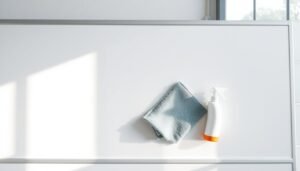
Keeping a small set of tools within arm’s reach made daily maintenance almost automatic for me. I store a stack of microfiber cloths, a refillable spray with isopropyl alcohol, and a roll of paper towels nearby. This kit saves time and helps prevent stains from setting into the surface.
Prep and safety matter. I always crack a window or run a fan when I use stronger products. I test a small corner first and tape over wooden trims if I plan to spray near them.
- Mist the whiteboard lightly with a mild alcohol solution or whiteboard cleaner.
- Wipe in overlapping passes with a microfiber cloth, using broad, gentle strokes.
- Follow with a water-only pass, then buff with a paper towel or clean towel until the surface is ready for markers.
For quick touch-ups I spray the cloth, not the board, to protect frames and nearby glass. Microfiber outperforms a felt eraser for lifting ink and reduces ghosting over time.
How to clean dry erase board like a pro
I found that light, repeated passes with a cloth and alcohol-based solution gave the best results without streaks.
Everyday clean: For routine maintenance I use a DIY isopropyl solution in a refillable spray. It cuts through fresh ink fast, dries quickly, and costs far less than bottled whiteboard cleaner. If I’m out, hand sanitizer with alcohol works in a pinch; spread it thin, wait a few seconds, then wipe and finish with a water pass.how-to-clean-tv-screen
Deep clean cycle
When light ghosting or streaks appear I switch to a focused cycle. I do an alcohol wipe, follow with a water-only pass, then buff dry with a clean towel for a uniform surface.
Product-by-product methods
- Isopropyl alcohol: my go-to for quick, reliable results.
- Vinegar + warm water: a non-alcohol option for light marks.
- Hairspray or hand sanitizer: used sparingly for stubborn spots, then rinsed with water.
When microfiber beats an eraser
Microfiber towels lift ink instead of smearing it. For used whiteboards, microfiber gives clearer writing and reduces ghosting compared with felt erasers.
| Product | Best use | Notes |
|---|---|---|
| Isopropyl alcohol | Everyday & deep cleaning | Fast drying; economical in a spray |
| Vinegar solution | Light maintenance | Gentle, non-alcohol option |
| Hand sanitizer / Hairspray | Spot removal | Use sparingly; rinse with water |
whiteboard care guide has more routines I tested and timed for consistent results.
Fix stubborn stains, ghosting, and permanent marker mistakes
Tackle set-in marks with a short, reliable routine that balances gentle abrasion and solvents.
Erase ghosting: I start with an alcohol wipe-down and then erase more often for a few days. This timing trick alone cuts lingering ghosting on a whiteboard surface. Use a microfiber cloth so you lift ink instead of smearing it.
Permanent marker trick
For permanent marker mishaps I trace every stroke with a fresh whiteboard marker, let it dry fully, and then wipe. That over-trace lifts the old ink reliably. If you want a compact guide, see my tip to remove permanent marker.
Advanced restoration
When a board has years of embedded stains I use toothpaste scrub in small areas first. Toothpaste is mildly abrasive, so I reserve it for old, stubborn spots only.
Next, an isopropyl alcohol wipe removes paste residue and evens the surface. After that I apply WD-40 with a paper towel, let it sit for a couple of hours, and then wipe until dry. Ventilate well—the odor fades with time and airflow.how-to-clean-oven
What not to use
“Avoid abrasive powders, coffee grounds, and heavy scouring products—they can scratch and worsen marks.”
Do not use Comet, Deep Heat/Bengay, or coffee grounds. Those products damage finishes and make ghosting worse over time.
Make your whiteboard last years longer
A few simple routines saved my surface from heavy staining over time.
Daily habits matter. I erase at the end of each session so ink never sits long. That single habit prevents many stains and keeps whiteboards writing clearly.
I stick with quality markers and never use tape on the writing surface. Adhesive pulls the finish and leaves residue that attracts ink. For shared areas, I label a caddy with my spray and towels so everyone uses the right products.
WD-40 resurfacing cadence and smell-management tips
I only resurface with WD-40 when ghosting comes back—usually every few months for heavy use, less often for occasional use.
Apply, let it sit for several hours (up to a day), then wipe fully. I ventilate the room and dry excess with paper towels until a finger swipe leaves no smudge.
Small routines that extend surface life
- I use microfiber towels for daily wipe-downs and wash them often so they don’t redeposit ink.
- Between deep cycles, I reach for isopropyl alcohol in a refillable spray for quick spot work.
- I keep spare towels, markers, and a small area scan in my wrap-up routine—corners hide residue.
- I avoid coffee-based DIYs and abrasive powders; toothpaste is for stubborn spots only.
Quick reference: for best practices on resurfacing and maintenance, see this clean whiteboard guide.
Conclusion
I learned that small daily habits beat occasional deep scrubs for long-term care. With an alcohol-based solution, a water-only pass, and a final buff, my whiteboard stays ready for the next session.
Microfiber cloths and a labeled spray bottle make routine cleaning fast. I erase at the end of each use, keep a spare towel and paper nearby, and test any strong cleaner on a small area first.
For stubborn marks I trace with a dry erase marker, let it set, then wipe. When restoration is needed, careful resurfacing reduces ghosting. For a short melamine dry-erase board polish guide, see this whiteboard cleaner resource.